The Maldives Meteorological Service (MMS), in collaboration with the Climate Change Department of the Ministry of Tourism and Environment, hosted a High-Level Dialogue and Stakeholder Engagement Workshop on 30 March 2026 at Meerumaa Events Hall, Malé, under the SOFF-funded UNEP Investment Phase in the Republic of Maldives. The event also included the Inception Workshop of the GCF-funded TRACT Project.
The workshop was officially inaugureated by the Chief Guest, Mr. Ibrahim Minister, Minister of State Tourism and Environment, who delivered the opening remarks. The event also featured remarks by Mr. Hao Zhang, United Nations Resident Coordinator for the Maldives, followed by a video message from Ms. Dechen Tsering, Regional Director of the United Nations Environment Programme (UNEP).
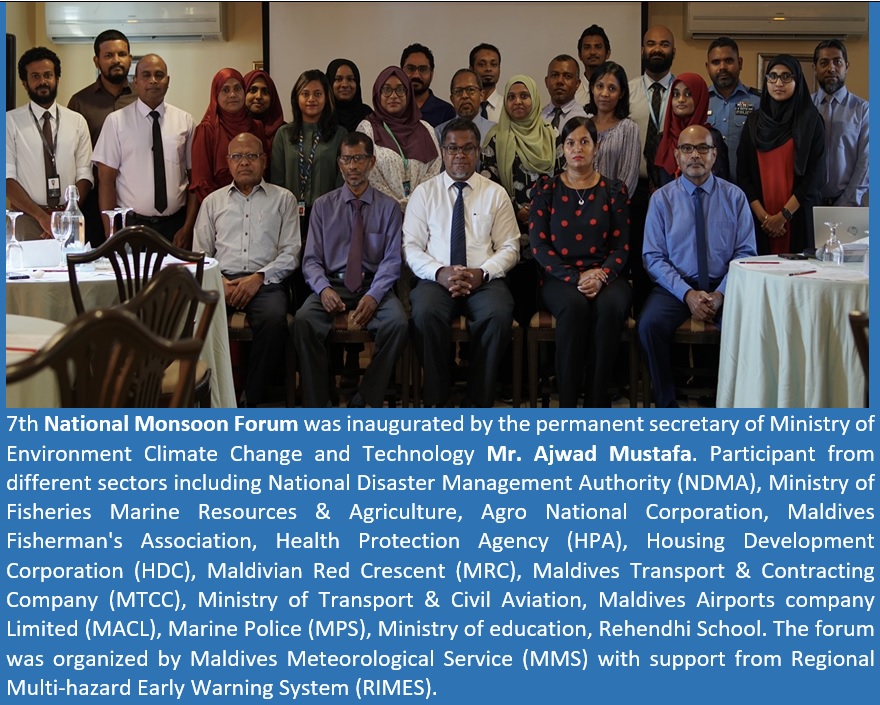
The workshop brought together representatives from government institutions, technical agencies, development partners, civil society, academia, the private sector, and international organizations to discuss strategic priorities for strengthening systematic observations, climate services, and multi-hazard early warning systems in the Maldives.
The SOFF-funded component of the workshop focused on the strategic importance of strengthening the Maldives’ national observation network and enhancing stakeholder understanding and ownership of the new Global Basic Observing Network (GBON) infrastructure. The workshop provided a platform to discuss how improved observation systems can support better forecasting, stronger climate services, disaster preparedness, and national resilience.
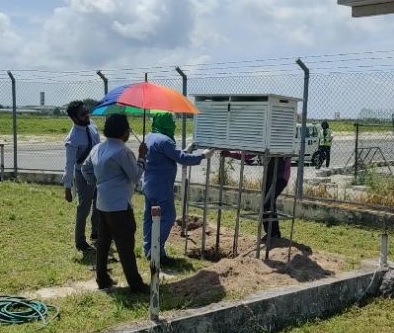
The Systematic Observations Financing Facility (SOFF) is supporting the Maldives through the UNEP Investment Phase Project, which is implemented by UNEP and executed by MMS under the Ministry of Tourism and Environment. The project aims to address critical observational data gaps, strengthen institutional and technical capacity, and improve compliance with World Meteorological Organization (WMO) standards for data generation and exchange. Planned interventions include the upgrading of four existing surface observation stations, the installation of one new surface station, the upgrading of one upper-air station, as well as improvements to ICT systems, technical training, and institutional development.
The SOFF initiative in the Maldives is further supported by the Finnish Meteorological Institute (FMI) as Peer Advisor and the Regional Integrated Multi-Hazard Early Warning System for Africa and Asia (RIMES) as Technical Partner.
The event also featured the Inception Workshop of the GCF-funded TRACT Project — Toward Risk-Aware and Climate-resilienT communities (TRACT) – Strengthening climate services and impact-based multi-hazard early warning in Maldives. Funded by the Green Climate Fund (GCF), the TRACT Project aims to strengthen the broader early warning value chain in the Maldives by enhancing disaster risk knowledge, observations and forecasting, warning dissemination and communication, and preparedness and response capabilities.
Throughout the workshop, participants engaged in presentations and discussions led by MMS, UNEP, RIMES, FMI, the National Disaster Management Authority (NDMA), the Maldives Red Crescent (MRC), and the Communications Authority of Maldives (CAM). These sessions highlighted current progress, technical priorities, and opportunities for stronger coordination across sectors in support of the Early Warnings for All (EW4All) initiative.
MMS remains committed to working closely with national and international partners to strengthen meteorological observation systems, climate services, and early warning capabilities for the safety, resilience, and well-being of communities across the Maldives.